
INTRODUCTION
In a blog your posts are the content. And there are a number of rules you must follow.
Write quality content.
Answer peoples problems aor provide for there needs whatever that might be.
Write what is toppicle – what people want to read about – not what you want to write about.
Make it personal – own it – its yours – brand it somehow that makes it you. If people don’t like it then change it but you need et be unique.
Write in a certain way that suits the Google crawlers without compromising the above
As you become more involved in the art of writing you will find there are many different approaches that people take. Some can just keep it all in their head, the main sub-headings, the first draft, the first and second edit and hit publish.
For me its almost impossible to be satisfied with the end product unless I have researched it well taking notes, organising those notes first, entering the sub-headings then bashing out the first draft and doing the real writing during the first and second edits.
Only with this method can I be satisfied that I have constructed a post that I can be confident is better than the competition, flavoured with my own style, and that embellishes the whole problem being attended to. If I haven’t achieved this then I do not feel content in myself, and I have let my blog an the brand I hope it to become down.
Its competitive world and to just write for the sack of getting out content is unsatisfying.
So I will describe my method here but if it does not suit your style or you can improve on it in some wy that is more suited to your method then go for it.
HAVE MANY ON THE GO
Your content goes here. Edit or remove this text inline or in the module Content settings. You can also style every aspect of this content in the module Design settings and even apply custom CSS to this text in the module Advanced settings.
THE PROCESS
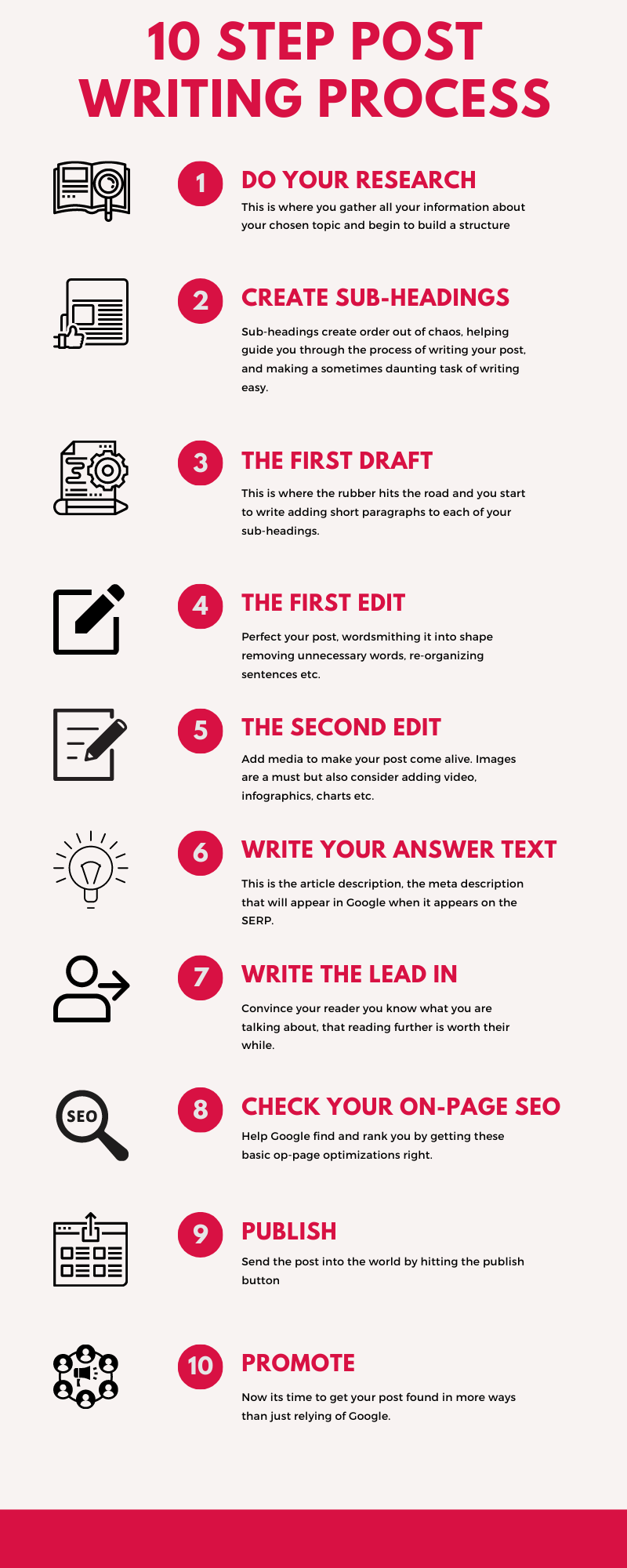
Talk about the above then do a chapter on each.
1. Decide what type of post you are going to write.
This will impact the degree of research you launch into, the design of your post, and the way you eventually promote it.
These 10 steps will help make the task of post-writing simple for you. It is your most important activity ad so you have to get good at it.
Remember the post is your product.
I usually do my research using pen and paper first – it is much more broadband than the computer. You can cross things out – scribble notes, re-order the sub-headings and add ideas for supporting media in a quick fashion.
Once I have finished the research stage, I then go into the post editor and start by adding all my headings in the correct order. they may not finish in this order but that is where I start.
Next comes the first draft where I don’t pay much attention to how bad the sentence and paragraph structure is, I just bash my thoughts in quickly.
Then during the first draft, I spend time wordsmithing the text, re-ordering sentences, shortening overly long sentences and paragraphs, removing necessary words
The second draft is where I create and add any media that I want to include that I think will embellish the post. Note that I am thinking about this all the time and noting the media I think will be needed on my research pages, but this is where I formally add it.
this might seem like a long process but it works for me. You may need to amend it to suit how you like to work – I know many professional writers who do not use the pen and paper step at all but I just don’t know how they keep all there ideas in order.
Its really up to your to create a method that works for you but remember – your content is your product – and your product is in competition with everyone else in your niche so it has to be better.
ANALYZE THE TOPIC BEFORE YOU START
What do I mean by “analyze the topic before you start”?
Its important to understand clearly that the type of post you write and the way that you write it will be determined by the topic that you have chosen to write about.
What’s most important to remember is that you are usually solving a problem for someone. Most people that go to Google to search are looking for something. What that something is will drive that way you construct your post.
The thing that they are looking for might be instructions on how to fix something, how to achieve a goal that they have, where to find a type of entertainment. Examples of the things people are searching for might be:
- What are the great sci-fi books of the last century – they are probably looking for something to read in their interest set,
- How do I fix the small dent in the side of my car – have probably just hit something in their mother’s car and need a quick solution,
- How do I put up this tent – is probably on a campsite and struggling with a tent they have never used before.
- How do I grow more succulents – are probably looking for instruction in how to propagate succulents.
- I just want to read about interesting stuff – give me weird and wide-ranging articles on anything.
- What stock market shares should I buy – Which shares will make me money.
The point I am trying to make here is that it is not good enough to just start writing and hope that you hit the mark. You need to think like your reader an, putting yourself in their place and trying o help them achieve something.
If you are writing a blog about camping and you write an article about putting up a tenet and the article just waffles away at the general task of putting up a tent then the person reading it will probably become frustrated and end up having to find another article. How frustrating is this. to only that but in the eyes of the reader they will remember the article author and actively avoid future articles by the author.
Every blog represents you, it will become your brand. Building up a consistent and quality set of posts will help you build a consistent readership.
Doing this will help you do these things:
- Decide the format or type of post you will write, and,
- Help direct and speed up the research that you will need to do before you begin to write.
So; do these things, answer these questions about the topic you are writing about.
What is the exact problem I am going to help someone solve and what will the solution most likely look like?
This is just your initial best guess. It may change later but it will get you going in the right direction.
Do this now!
Below where you wrote the topic title write down what you think the exact problem is, what is the likely use of your post, who will be reading it, what do they want to achieve after reading your post.
What format will the post likely take?
RESEARCH
This is possibly the most important step in the process. The quality of your post will depend greatly on the equality of your research. This step will take you through a number of steps. Yu need to achieve several things when researching a new post.
Examine the current literature
Reearch the competition – will help inform you of your position – invoke your URL and the needs of your audience
Understand your audience – how are they asking for info, what type of info are y]they after,
It will also lead you to opposition posts that solve the same problem which is necessary so do not feel squeamish – you are not copying their material. You are going to be going to a number of sources, perhaps even doing some of your own principle research, other books on the topic, canvassing views on Twitter or Facebook perhaps. gathering information from as wide a selection of sources as possible will help you form a strong opinion on what is right and wrong about other approaches.
It’s not wrong to research your post by reading other posts on the topic. It is wrong to plagiarize. Don’t do it. It can have devastating effects on your blog rankings, your authority, and your standing in the community. And know this a computer finding and ranking system like Google might not be able to actually read a post but it is easy for a computer to find match things like two documents, or parts of documents that are identical. Universities use programs that d exactly this to check their students are not plagiarizing.
Its ok to quote another work so long as you give it the credit. Something like – Mr Brown in his article on x said, “this…,” but I disagree because is fine, or I agree etc. But provide the link to this source as well – Google likes that
So lets get going. At this stage I am using pen and paper. I am writing down the ideas as I come across them in my reading, circling ones that I think will become headings, crossing out other stuff that I think is unnecessary, underlying important points that will need to be emphasized, noting down ideas for images, or videos or dials and infograhis perhaps.
Anything that I think I will need, as well as the information that I need I scribble down.
What sources are their that you can explore.
Opposition Research
You need to start here. The is not much point in creating something that is just the same as the opposition. In marketing terms this is just a me-too product and it is difficult to compete this way.
Keyword Research
This will be your first stop. Knowing what the correct reader language is – what others words match, is it a good keyword.
So do this first – Google Trends and Google Ads
Keywords anywhere
and if you buy a professional provider then
This will probably be where you will start for most things. It will give you a flavour for the opposition and set the bar for who you need to be better than. These opposition posts will also start to give you a structure for the post, the sub-headings that they have used will be useful but don’t be afraid do disagree with their headings and outcomes. Let the document become yours . If you disagree with something in another post then say so, but only if you can support that position with evidence.
Note the areas you think the article you have read could be improved, create a scoring system if you are reviewing, or an infographic if it lends itself to a r
Doing this with pen and paper will enable you to develop things that the screen is just not capable of.
Quora
Quora is an online community site where people ask questions and others answer them. It hs bult up a relatively high quality of input in terms of both answers and questions. They reward people for asking questions and do not tolerate over-promotionally slanted answers. People using it to just plug their posts or products without first adding value to the question asked are quickly excluded from the site.
As a consequence the site is really useful to use in your research. You can either ask questions related to the topic you are researching yourself or search for questions already asked on that topic.
The responses can be broad and diverse and also point you to the opposition posts you can use for your research. Its a great resource and I suggest you join and use it.
Here is an example.
Serch your news feed or the site in general for information on the topic you are researching. What you are most interested in here is the opinions people have made about the topic and pay particular attention to the language they have used. This will give you a guide as to the language to use in our post – it helps you develop the language of the issue, the way people talk about the topic and this will reflect the way that they searc for it. these are clues to keywords that you can exploit to help get found by Google.
Also take note of the media they are using. Is there any commonality in the type of images people are posting, which of these images should I look for or generate myself.
Much the same as above but with a more concise outcome.
YouTube
Watching a few youTube videos, taking notes as you watch can give you a grat deal of insight into the topic quickly. Being a visual medium it will also give you image ideas as well as ideas for a video you can create yourself to support your post. more and more posts are appearing now with short embedded videos to enhance them, particularly recipe videos.
Keep an eye out for ways you could improve the advice, things you would do to improve the video that you might incorporate etc.
Magazines
The good thing about using printed magazines is that if the magazine is a popular one then you know already that the articles they write are probably pretty good. The cost of production nd distribution is high so you know they will be following the trends pretty closely and producing high quality content.
Your task as always is to just take notes, jot down media ideas, add to what you have already collected, collect possible quotes. Reproducing the same article online is wrong and wont work anyway. This article no doubt already exists online, and me-too products do not generally work.
Your blog and its posts needs to break new ground or do something different to be a success.
Books
Books and the library is an obvious source of material. This will depend greatly on the type of post you are producing but libraries are a great resource of free material including magazines that you can easily tap into that can also often dd uch greater depth to your article.
Jut join the elocla library and take your note pad, find a desk and get reading.
Is All This Really Necessary
It will depend on a number of things.
- The type of post you are writing,
- The length of the desired post,
- How well you know the topic. You might know the topic so well that only a very short outline is necessary.
- How determined you are to be successful. If you genuinely want to succeed you have to realize that you are in a competitive environment. You are competing for eyeballs and people’s time. They do not want to waste their time so give them quality content and – they will come back, Google will find you, people will backlink you, and people will recommend you to others. Produce junk in the hope of just creating a clickbait site and you will not win.
- Your own level of satisfaction and pride will be embellished by the quality of your work. Work with passion and not for an outcome and you will be rewarded.
WHAT TYPE OF POST WILL IT BE
From th elist choose the type of post that best suits your strategy, the topic you are answering and the
Myth-busting posts
hghghg
Debates
hthth
Research polls
yhyt
Cheat sheets
yjj
posts with infographics
long-form posts
beginner guides
posts written with a bit of humor.
Posts that get shared a lot are good to write because they get you known.
They include the following types of posts
- myth-busting posts
- debates (people seem to like sharing them to justify their opinions)
- research polls (and the results)
- cheat sheets
- posts with infographics
- long-form posts
- beginner guides
- posts written with a bit of humor.
HOW AM I GOING TO ADD VALUE
From the liost below choose one of more ways of adding more value than the opposition research you have done.
1. Improve On The Material
During your research for the post, you find that it is a difficult area to follow or understand exactly what the answer is. Maybe you could add better images or photos, make a video to embed (and post on youTube), create an infographic or just write a better solution.
A great many post authors take shortcuts without realizing that they are. The material they are writing about is so familiar to them that they may leave out a step because it seems so obvious to them that they don’t need to include it. But it may not be obvious to your reader. So always be complete.
- Go deeper into the area adding more specific detail or making it longer.
- Add better photos that make the solution clearer,
- Format the article better by including clearer headings,
- Create a video that ou can embed and post on youTube,
- Adding a series of clear steps that are labelled “Step 1”, “Step 2” etcetera.
- Add some criteria to rate a product or service and include animated charts that give your ratings,
Look at this example.
2. Find The Gaps
What are people not talking about or leaving out? This can be difficult to spot but if you do spot it’s likely that others have noticed also and are possibly frustrated by it. This becomes a great opportunity to write a great post.
4. Change The Topic Around
So instead of writing about the 10 best of something write about the 10 worst of something and give better alternatives. For example. The topic might be the 5 best cheap cars to buy might become “Do not buy these 5 used cars! Buy these instead”.
or
‘Why is my toddler wetting the bed?” could become – “3 Common Ways To Stop The Bed Wetting”.
5. Develop a Different Approach
Find a different seemingly unrelated past time or behaviour and link them together. So for example if you are writing a topic about car maintenance you might change the topic from;
The 6 car maintenance activities you can do yourself” might become, “What these 6 car maintenance activities taught me about patience”
6. Narrow The Focus
If you start your research and you find that there are literally thousands of posts about the topic you are writing then maybe it would be a good idea to narrow the focus. So for example, if you are writing a post about the best camera filters to have in your kit bag”, you might prefer to narrow the post to something like; “The 3 must-have camera filters for your landscape photos”.
7 Expand On Someone Else’s Post
It’s ok to expand on an idea that you have read or heard someone else make so long as you acknowledge the source. So maybe there was an article you read that you feel deeply about or that you disagree with or you feel need some additions.
There are several ways to acknowledge the source.
- You could include a direct quote,
- Link to the post or podcast, youTube,
- Include the phrase “This post was inspired by” and include the link,
- Use a formal citation with the link at the bottom of the post.
CREATE SUB-HEADINGS
Sub-headings are one of the secrets that make post-writing easy. It gives you an ordered framework to create your post. Once you have finished your research, created, and ordered your sub-headings you simply write a paragraph or two on each sub-heading, and the job is done.
It can make the otherwise daunting task of writing 2000 words and turns it into 5 or some less daunting tasks, in fact, they are now not daunting at all.
However, the most important reason for creating sub-headings is that it will also lead your reader through the solution or task you are trying to help them in an ordered and structured way that is much more appealing than a dense document of just words. It gives logical breaks to the material and enables you to input other media such as pictures, videos, diagrams, infographics, or even cartoons.
the third reason you should use sub-headings is that the Google search crawlers (the programs Google uses to find and rank your posts) like them. Google has estimated that an article that is broken into sections of H2 and H3 sub-headings will be a better article than one that is not. And they are probably right.
Bringing It All Together
Bringing all your research together is for me at least a matter of reading through my notes, circling related material and connecting with lines, underlining potential sub-headings, crossing out material that I have duplicated, and then numbering the sub-headings and sometimes the material that goes into those sub-headings.
My final research document will look something like this.
Then as I write I will cross out the material I have added so I don’t go over the same material again.
the first draft
For me the first draft is about just bashing in the ideas that I have formed during the research and getting them in the rough order that I think they belong. The writing is generally poor, sentences are too long or in the wrong order, I repeat myself by saying the same thing in a different fashion but better than the previous way, paragraphs may be in the wrong order, and the ideas not fully fleshed out.
If I look back at the post after the first edit, and compare it to the first draft they are almost indistinguishable.
But I have got it all down on paper (computer) and so now it is ready to be wordsmithed into a proper post.
However way you progress from here is up to you. You my decide to angonise over the writing at this first stage and that’s fine. You will have less to do in the next stage. But now you just need to step through each sub-heading and write a couple of paragraphs that are pertinent to that part of the post.
Stay on track. try not to deviate away from the meaning of the sug-heading or you will be repeating yourself latter when you come to another sub-heading.
the first edit
This is where the wordsmithing takes place. You now need to re-read and change clunky sentences, remove unnecessary words, correct any poor grammar, move sentences and paragraphs around so that the solution you are describing or the review you are writing or the story you are telling flows, makes sense, is easy to read and most importantly is enjoyable to read. Remember you are creating a product and you have competition. You have to be better than them.
This is a skill you need to develop. It will only come with practice but there are some good resources that you can use to speed up the learning process.
Get Rid of Those Little Words
It’s the little words that clutter up sentences. Its amazing how easy it can become to remove them and it really sharpens up your writing, making it more authoritative, easier to read, punchy, and enjoyable. This is what I mean.
Examples
Make It Easy To Navigate and/or Skim
Create space – layout – bullets – etc
Resources That Can Help You at This Stage
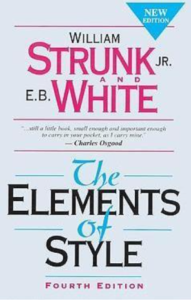
One of my favorite books is a book called “The Elements of Style” by W. Strunk and E.B. White. In fact, we used to call this step in our report writing – “To Strunk and White it”, meaning it was time to re-read the report and wordsmith it using their principles. I highly recommended you buy and read this book.
Nothing kills the legitimacy and authority of a post like poor grammar can. Expectations are high amongst readers. When they encounter poor writing in their searches it reflects poorly on the author and the post and the product overall. This book will also help you to write concisely, enabling you to develop the skill of removing unnesary words and can make reading your post more enjoyable to the reader.
Here is an example. Above is a sentence that I was going to change but I left it in to make this point. It’s the first sentence in this section – “One of my favorite books is a book called “The Elements of Style“. Can you re-write this with fewer words? Do you think this sounds better – “One of my favorite books is a book called “The Elements of Style“? See how taking out two unnecessary words “a book” makes the sentence so much easier to read.
As an author of posts, you will need to develop this skill.

Another resource I like is Grammarly (https://www.grammarly.com/). It’s an add-on to your browser and it automatically corrects your spelling. The paid version will also highlight poor grammar and recommend changes that you can choose to accept or not. It largely just sits in the background watching and advising. Well worth the investment in my opinion.
Add Your Media
This is also the stage where you add any media you have. Items like images, videos, audio recordings, infographics, charts, and dials, whatever is relevant to the type of post that you are writing.
The different types of posts have vastly different types of media needs but all posts should be embellished with life. Human beings are highly visual animals, pictures and videos make all the difference to most posts, particularly instructional posts like “How to’s”. Imagine trying to explain to someone interested in improving their golf swing how to do that with just words. It’s fairly difficult.
The reason this is done at this stage is that you want to ensure that the media you use is relevant and in the correct place relative to the writing. If we did it in the first draft we would find ourselves reordering not just text but also any media we had added and that can become a hassle.
Once you have re-read and wordsmithed your post go back to the beginning and read it again all the way through with no stopping. Ask yourself these questions:
- does it flow,
- is it solving the question asked,
- would I be happy with this if I was searching for this answer,
- how well does it stack up against the opposition answers I found while doing my research,
- have I improved on the opposition posts, taken the issue further
- made it more understandable, enjoyable.
the second edit
This stage is largely about just checking that the post as a whole hangs together in a structured way and that you are happy with the finished product. Be honest with yourself – is it the best article you have read with regard to the post-goal – does it answer the question, add value to someone’s life, solve a problem for them.
You also want to make the post easily scalable. That means using highlights such as bolding, italics, quotations, clear flow and headings, maybe even a contents section at the front. If your posts are easier to read they will be more popular.
Could you do what is being described? Are all the steps in it, have you reviewed the product honestly,
Again, the post is your product. Make it a good product, something you are proud of. Don’t just create content for content’s sake. How many times have you purchased the next edition of a magazine when the first copy you bought was rubbish. Remember, good business is repeat business. the best blogs develop loyal followings of readers who come back often. That is your goal.
Write The Answer text
This is the text what will accompany your link on the Google page (SERP) when somebody asks a question that contains the keywords you are targeting. It needs to fit so it should be no longer than 300 characters and it should simply answer the question straight up. Just dive in and give the answer.
This is why you need to write this part of your post after you have written all the rest. Now you wulll have firmed a strong opinion about the appropriate answer and have the ability to write it succinctly and confdently.
Consider this example. A reader type the following question into the Google search bar;
“What is the best kayak for beginner”
Here was one response from the SERPs that pings it.

Instantly you get an answer, someone has made the choice for you making it easy. Intrigued you dive into the article to see why and whether it really is the best, what else they compared it with.
This type of Google search will often get a listicle in response. On this search I got:
10 Best Kayaks for Beginners in 2021, and,
8 Best Beginners Kayaks in 2021 – Tested and reviewed.
These types of posts are popular and work well and if this was my blog site I would probably write another post using the same research that was a listicle.
BUYERS ARE ALL DIFFERENT
But the definitive answer is often what people are looking for. They don’t want to do lots of research and reading, they want someone else to do the work for them. When I was running my market research agency we ran a test in a small general electrical store to see what effect the amount f choice made to the consumer looking for a toaster.
Consider this research that I conducted for a client during my market research days.
there were three test situations.
Test situation one had nine toasters 3 from each of three price ranges, expensive, mid point and cheap.
Test situation two had 6 toasters, 2 in each price category, and,
Test situation three which had just one option in each price category.
Sales were measured over a three month period across 6 different stores for nine months rotating the range randomly.
To our surprise, and just about everyone else who was involved with the research teste situation three out sold the other two scenarios by a significant margin.
So, somewhat counter-intuitively, the less choice the consumer was given resulted in significantly higher sales.
Whats going on here. Well it was discovered that faced with less choice the consumer was more willing to part with their money and buy a product in the chosen price range and trust that the store had done ll the hard work for them and would only stock good product. It took away the confusion and the hesitancy and resulted in more sales.
Lets go back to our kayaks question. Will it perform better than a listicle. Its hard to tell but the confidence in the answer that accompanied the search would more than likely result in a lot of clicks.
And if the article is well written and convincing, probably by doing the same as a listicle and comparing the winner with 9 other kayaks then it will probably do the trick. And if a sale results from it through an affiliate link all the better for the blogger.
So be definitive in your snippits and “just answer the question in 300 characters”.
Write The Lead In
This is the first paragraph in th erest of the blog after the answer target is written. It needs to give the reader the confidence to continue to read further. So it should establish some type of authority and confine your reader that you know what you are talimng about, that what you have is worth reading.
Lets look at the kayak example again. What types of lead in paragraphs do you think would do the trick here. These are the sorts of things that would be a good starter.
“I have done 100’s of miles in kayaks of all shapes and sizes. Some are great and good value others should be avoided. Here is why I think this model is the best for beginners.”
Or maybe..,
“Testing the top 10 beginner kayaks on the market took me a week but after many hours paddling the river this one came out tops. It was a near thing though but across all 12 criteria developed for this test it was the standout.”
Write The Title
Your article’s title needs to achieve two outcomes. First, it needs to clearly communicate to Google what your post is about, and second, it has to attract readers. These two tasks can conflict so your article title is a complex skill that needs to be continually worked on. The course in copywriting will help with this.
In order to be found and ranked on Google, Google needs to be confident that your post matches the search that one of its users has made. It does this by matching keywords from the search text to the post title, and other places in the text of the post. So your title MUST contain the keywords you chose when deciding what post article to write.
If your post is found and sufficiently ranked by Google you will win the coveted first-page listing in the search result. Your task then is to convince the searcher to select your article from the array of selections that Google has produced, which can include videos, podcasts, and written posts. Your title is in effect an ad for your post and it needs to work hard to get that click. The course on copywriting will help you here.
So take your time and work hard on this part of your post. The great advertiser Ogilvy would write up to 30 attempts before he was happy with the result. You probably don’t need to be that obsessive but try many different wordings until you get it just right.
Check Your On-Page SEO
SEO is a big topic and there is much to learn. That’s why there is a separate course on it which you need to do. But in the beginner stages of your blog site, you just need to take care of the basics and this list of basics needs to be applied to each post that you write.
So after finishing each post step through and do these nn things and you should be ok at this stage.
This checklist will guide you through a predictable process for every post that you write. these are the structural things you need to do. The SEO course will take you through the bigger picture of how to get Google to rank you.
ON-PAGE SEO CHECKLIST
1. Optimize Title Tag
2. Optimize the URL Tag
3. Optimize the H1 Header Tag
4. Optimize Sunheadings – H2 and H3 Header Tags
5. Optimize Images
6. Optimize First Paragraph Text
7. Optimize Paragrph Text
8. Optimize Meta Descriptions
9. Optimize Images
Two Methods Of Optimizing Your On-Page SEO
These two methods outline how to make sure every post is SEO optimized. The first is the manual method using the Gutengerg WordPress editor.
The second is a WordPress plugin called Yoast and it is the one that I tend to use. Its free so go ahead and install it.
The links below will take you to the relevant sections of the SEO course. Its worth doing these elements of the SEO course now.

To see how to complete these steps using the Gutenberg editor click here.

Yoast is a free tool with a more advanced paid version. Its a good service because it makes the job of no-page SEO easy. The plugin appears at the bottom of each page and provides visual tools that make the job of on-page SEO easy. To learn how to use the Yoast plugin click here.
Publish
All that is left now to get your new post online is to press the “Publish” button. But that’s to the end of the process – you now have to promote it.
unnecessary
Promote It
Promoting your posts is essential and is dealt with in considerable depth in the “Marketing” course. I mention it here because it is a part of the post process. After studying the marketing course and having developed your marketing strategy you will have a list of activities to do now that will help to get your post noticed.
This list will includes things like creating a “Pinterest” image and uploading it to your Pinyerest account or sending the post to your list of readers.
Its all part of the process of being a publisher and blogger.