
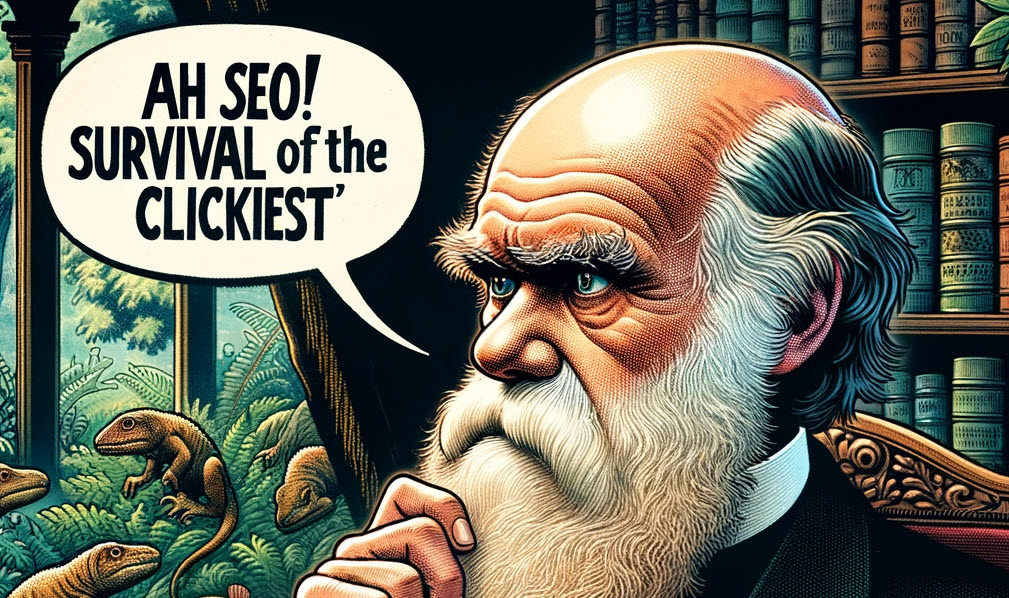
Eureka! Or So I Thought…
Imagine your name is Charles, an aspiring natural scientist, and you have just started a blog. You’ve had this groundbreaking, earth-shattering idea, so you make it the subject of your first post.
You have discovered life on Earth may result from random mutations in genes that prove so beneficial to an organism that they provide it with an advantage. This advantage enables the organism to breed more often and thus pass on these advantageous genes. Enough of these mutations, and you end up with a new species.
You write up the idea, post it to your new blog site, and wait for the inevitable eruption from your academic mates. Six months go by, and nothing, not a peep or a quaint, quiet inquiry. You ask around because your colleagues are always on Google, looking for the latest species-related scientific developments. But nope, no one has seen it.
Further investigation reveals that Google, the internet god, has found and indexed it, but it’s so far down the rankings that no one will ever see it. Apparently, the first page of the Google search result is what it takes, and it only has space for ten suggestions. Humans are not inquisitive enough to go beyond the first ten suggestions of anything.
So – how do I get onto the first page of the Google search result page? Something called a SERP. With further investigation, you learn about a new phenomenon: SEO. Hmm, search engine optimization. Being up for the challenge, you dive right in.
SEO: Easy as A-B-C, Right?
I take my first tentative steps into the world of SEO with the most obvious first step;
a Google search. How do I do SEO?
Several million posts are found, but the first ten are apparently all I’ll need. They all started with the same title – “The 5, 7, or 10 most important ranking items for great SEO”.
I picked the first article on Google’s list, “The 5 things you must do to have your post rank on page 1!” and started with the first suggestion – Make Sure Your Keyword Appears in The Title.
I called my post – “On the Tendency of Species to Form Varieties; and on the Perpetuation of Varieties and Species by Natural Means of Selection.”
Undoubtedly, the keyword “species” is important enough for me to appear on the first page of the SERP. Let’s google it. Nope! Seemingly, B-grade science fiction movies are far more critical. The first page of the search result is full of articles about the movie franchise “Species.” Maybe I should see it.
The following SEO item on the list suggests that if I am new to blogging, I should use a “long-tail” keyword. It’s something like the word species but not as commonly used.
OK, what long-tail keywords could I use for the term “Species”? Ah, yes, “Ecosystem diversity” seems like an excellent long-tail keyword. I’ll use that instead. My article is now called – “On the Tendency of Ecosystem Diversity to Form Varieties; and on the Perpetuation of Varieties and Ecosystem Diversity by Natural Means of Selection.”
It sounds silly, but I’m sure I’ll get noticed now.
Nope – still not succeeding. Too long a tail, perhaps.
Onto the next SEO item. Apparently, the optimum length of a post is 2,000-2,500 words.
Well, how dumb is that, I think to myself. Is quality really measured in word counts on the internet? Horrified, I set about removing 34,000 words. Will anyone understand it now, let alone believe it?
I checked with a search again. No change. Still not on the first page.
What could be next?
Number three in my SEO article says that the quality of my website will largely determine my post ranking. Further, the god of the internet, Google, won’t rate my website as an authority and, therefore, rank my post highly unless I have 30 or more articles on my site.
Apparently, writing a lot means you are good.
Phew, 30 more ideas like the evolution of species to come up with. It took me ten years to develop this one. How am I going to achieve this?
I think I’ll move on to the next SEO item.
A thing called Backlinking? What could that be? Apparently I have to get other people to provide a link to my paper before it ranks well on Google.
OK, now I’m confused.
No one can find my paper because it doesn’t rank on Google, and I can’t rank without backlinks, which I can’t get because no one can find it in the first place. Joseph Heller would have been proud of this one.
Before I trash the idea of species evolution for a better idea I’ve been working on – “cold fusion,” I’ll try one last thing.
I have 200 flyers printed and place them on the inside doors of men’s bathroom cubicles near the biology departments at every major university in England. With my web address unmissable and a QR code for that extra tech flair, I’m sure to catch the eye of every budding biologist during their most contemplative moments.
Eureka! Suddenly, my blog has taken off. All my colleagues are visiting my page, and the ensuing rage over my thesis has caused so much commotion on the internet that the Google god has finally noticed me.
Turns out SEO only gets you so far.
The Real Deal with Google’s Limitations: A Wake-Up Call
OK, OK, stop howling.
I’m being facetious. But there is a strong message here for business bloggers, particularly beginners.
Google is a lagging indicator.
Google is waiting for your post and blog site to show signs of performance before ranking you. It’s not going to put your posts on the first page of its search results until you are already getting page views, backlinks, or being noticed elsewhere. It lags behind your content, no matter how good it is.
Simply, Google cannot read or make judgments like humans can. It can only count. So that’s what it does: it counts. Things like page views, the number of posts your site has, how frequently you post, how recent you have published, the number of words, and approximately 200 other items go into the Google ranking algorithm.
For most searchers, this is fine. Google’s job is to provide quality search to its billions of users searching for all types of digital assets – like funny cat videos. That’s its product. Frankly, I am awestruck by the sheer amount of data that Google analyses daily. And by and large, they do a pretty good job.
But it’s a problem in at least two situations. Firstly, genuinely unique breakthroughs like the evolution of species will be totally missed by Google. Google is not going to be an indicator of trends or new discoveries. It’s not going to notice a trend until a large number of other people decide that it is already a trend.
Google is simply going to wait and count, and when that activity is large enough, it will lift it in the rankings, hopefully to the first page.
Secondly, and most importantly, new business bloggers with a new blog will not get any traction on Google Search until the counting of your whole blog site becomes sufficient. The wait is typically 6 to 12 months and requires a steady production of good content and a well-optimized site that is already being found by others by other means.
Forget Algorithms, Embrace Classic Marketing
So what’s the solution?
Learn marketing!
Marketing is about the “4 P’s” – Product, Promotion, Price, and Place. It’s about identifying a target audience, fulfilling a need, going into the world, and telling your potential audience you exist.
Your blog site, its content, and the inherent value it adds to people’s lives are your product. Once you have a product, you need to tell potential readers you exist – that is, you need to promote it. Nurturing trust and cultivating a dedicated audience is where the real journey begins.
Embrace platforms like social media, forums, and discussion sites like Quora to sidestep Google’s lagging impact. By forging connections with your target audience, crafting compelling content that captures attention, content that spontaneously encourages bookmarks, garners organic backlinks, and sparks word-of-mouth recommendations, you can go around the Google roadblock and build an audience. When you achieve this, Google will naturally gravitate towards you.
So study marketing. Absorb the theory and develop the skills. Learn about the four Ps, mainly Product and Promotion. You need to build a great product and then tell people about it. It’s what a business is. It’s silly to wait, and hope that Google finds you.
Lastly – be patient – if you create quality content, your time will come, and know this. When Google does find you it will supercharge your business. Till then;
Learn the theory and skills of MARKETING and go around Google, not through it. It’s the one vital skill set every business blogger must excel at.
0 Comments