
INTRODUCTION
For a blogger, the “Post” is your product. It will define your site and ultimately its success. Produce a lot of content that is below par and you will not rank on Google and you will not develop a following.
The correct mindset or approach will take you far. Realize that you are a publisher, the chief editor, and it is a competitive world. If you do not produce quality content for your blog site (online magazine) you will fail.
A post is any piece of content you create and “post” to your site, whether a written article, a video, or an audio file. In this course, we will examine the issues affecting the written post. The written post is one you should master even if you are producing a YouTube channel or a podcast channel. Both YouTube and Podcasts should be supported by a website. It will help you organize your work, give it a structure, provide an advertising arm for your channel and help monetize your effort.
We will cover the types of posts, post length, the time it takes, its layout, and your style.
In the next course, we will look at a process that can give you “discipline” to help you be productive.
Remember to stay “on brief”, stick to your marketing plan and direction, and write what your target audience wants to read, not what you want to write. We will look at this in the marketing module courses.
WRITING
Writing can be a daunting task for the new blogger, especially if it has not been a skill you have had to learn previously. Where do you start, you can’t think of that first sentence, you think that you have never been that good with words, you think you don’t have the ability, what will your friends think of your work. These are all common doubts and fears that all writers suffer from.
There is only one rule “just do it“. Sound familiar? It’s of course the tagline for much of Nike’s advertising and promotion. It’s a very powerful statement and it’s commonly found in the teachings of “Zen” living.
“When doing something, just do it.”
I’m not going to go off on a tangent now and speak about zen thought but the point is if you want to be a blogger then you need to write posts. When you write posts “just do it”. When you focus on the task at hand and just do it, you realize that all those fears and doubts you had are external to you, they are imposed on you by others. Focus on what you are doing right now and those externalities disappear.
Your first few posts may not be very good but the important thing is that they will get better. And with the right commitment and honest self-appraisal, they will get better, much better. In the next course, we will look at some resources and methods that can help improve your writing but it’s also important that you actively seek out and read about how to be a better writer.
There are a great many materials available online, also books and courses you can take. But you are a writer now so it needs to become a skill you constantly work on.
WRITE FOR YOUR AUDIENCE
Remember you are writing for your audience, not for yourself. You need to know that audience, what it is that they are searching for and how they are doing that search (keyword analysis), and what their motivation is.
Your audience’s motivation will be driven by your niche topic, your strategic plan, and your monetization strategy. Let’s look at some examples.
If you are writing a travel blog and a part of that blog is to review budget hotels around the United States then you should already have a pretty good idea of what your readers are looking for. They are looking for your recommendation for a budget hotel. Maybe they are planning a trip to San Diago, and they need to book an inexpensive hotel for several nights. Their search results would look something like the following.
A site like “https://budgettravel.com” with the following posts:
- The 7 best budget hotels in San Diago and why you should choose one of these.
- The Plaza received our highest score on the 7 most important hotel criteria. These others were also great.
Or another site – https://travelonabudget.com, and their posts:
- Hotels with ambiance but at a budget price.
If that is your target market then these articles would have a chance of ranking on Google. If you wrote articles on premium stays then you would not rank. So know your target audience, focus on their needs and write for them, not for your desires.
If on the other hand, you were writing a blog about funny cat videos that are designed to entertain then the message you need to convey is one that will convince the potential audience that yours is the place to go.
- Funny moments that only a cat can provide
- Cat videos that will make you laugh
Be cognizant of your target audience, their desires, and needs, and make sure your site (your product) answers that promise. This is marketing 101 and we will cover it in detail in module 4.
SEO CONSTRAINTS
Writing successful blog posts that have a chance of being found and ranking on Google places a number of constraints on your writing. This is unfortunate because the winning post may not be the best writing but one that follows Google’s search algorithm rules.
This is not true for major publications such as the New York Times for instance. Their audience comes for the promise that is the New York Times and then look to be entertained by the articles that they produce. They can use headlines and abstracts that take advantage of the human being’s mind, the most powerful computer available.
Unfortunately, your posts need to conform to Google’s limitations and so your writing will need to be adjusted accordingly.
Let’s look at those constraints now.
Keywords
Google’s task is twofold. Firstly it needs to scour the world wide web looking for all the online assets it can find and categorize them so that, when requested, by someone typing a query into the search bar, it can list off the locations of the online assets it has in its database that it thinks answers their users needs.
If someone wants information on how to shoot quality photos with an iPhone in low-light situations, it needs to be able to search its database of online items, and return to the user a list of useful information, including posts, images, and videos that it thinks to answer that query.
Secondly, Google needs to determine which, of all the material it has on file does the job of answering that query the best. We will look at how it attempts to achieve that later in SEO.
Google’s categorization process has created the term, “Keywords”. Keywords are single words or phrases that identify for Google the content that their users are searching for. Google wants to be sure that its search result will return accurate suggestions and so it looks for these identifying signatures, “keywords” in multiple places in a post.
Google gets these keywords from the title of the post and looks for further evidence by scanning the first paragraph, the sub-heading titles, the metadata of the document, maybe the images if they have been labeled accurately, and several other sources.
Let’s use the above search question as an example. “how to shoot quality photos with an iPhone in low-light situations”
Below is what is returned on the first page of the Google search result known as SERPs, (Search Engine Result Pages).
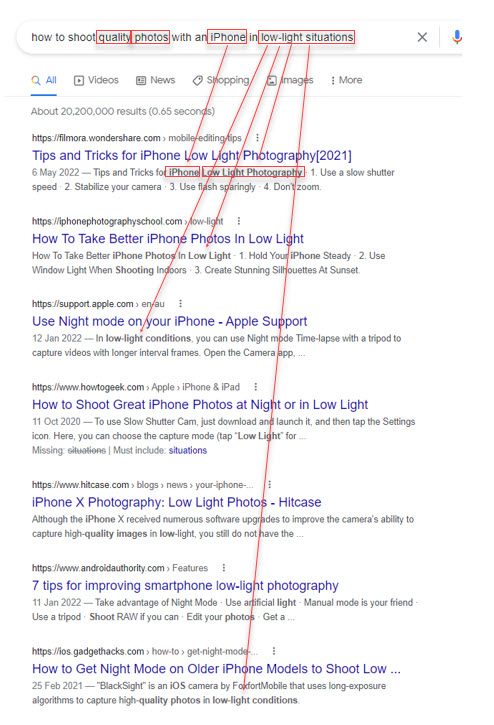
Google also lets you know which keywords were important by bolding the words that match the search query. You can see that the words, “photo”, “iPhone”, and “low-light”, were the paramount keywords that Google used to match your search to its database of posts. The word “situations” was matched semantically to other words that mean the same thing; in this case, the word “conditions” was used.
Google also tells you which words are missing from some suggestions by highlighting the words missing like this.
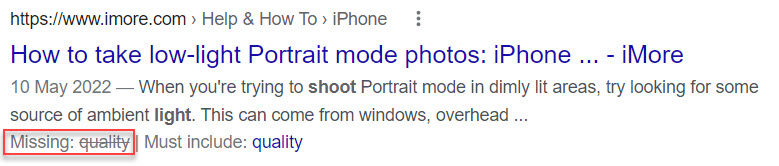
So why is this a constraint? In giving your post a title you must be explicit in describing what it’s about or Google will not categorize it correctly. A more seductive or effective title like – “Dim lighting is no problem for the iPhone photographer” won’t get you the larger audience you are looking for.
If you type this into the Google search bar you get a different result of links. Although still broadly on-topic they are more technical in nature and not the target of your post.
So remember;
Google can’t read. It scans and matches patterns of words.
In writing your post you need to be explicit about what the topic is in several places of the text in the post, in particular the title, the opening paragraph, and sub-headings so that Google can be confident that it is what their users are looking for.
Now it gets a little more complex. People don’t word their searches in a consistent way. There are many many ways of asking the same question even if it is for the same thing. But Google can’t really cope with this. There is a wide range of ways of asking the same question and Google creates a keyword for each of these different ways. This is where the concept of long and short-tail keywords comes in. (Much more on this in the marketing module)
You can use this to your advantage, which we will look at later, but for now, be aware that you can use different titles for essentially the same post depending on your marketing strategy, but you have to have a reasonably dense occurrence of the keyword you are targeting in the early parts of your post.
You should have noticed now just how important keywords are. Don’t panic – we will be covering this topic many times in detail in the coming courses – especially the marketing module.
Post ranking
In the example above Google told us how many digital assets (posts, images, etc) it found that related to your search. In that case, it found 20,200,000 matching items in its database. So how did it determine which 10 to show on its first page of results? That is the subject of a great many articles, videos, books, and debates and has spawned a whole industry of professionals willing to take your money to help you get to that elusive first page.
But from the outset, you need to get there on your own. And that takes a lot of time, patience, and effort.
These are the broad rules that the Google algorithm uses to create a rank score. That rank score will determine in what order and on what page of the search engine result pages your post is placed. You will come to appreciate just how limited Google is, and how it must make broad assumptions in judging what is good.
There is much debate about what is a good post but in the end, it is mostly a moot argument. What is important is what is important to Google.
By studying what is important to Google you have entered the world of SEO (search engine optimization). There are over 200 items Google considers when ranking a post. Not all of them have anything to do with the actual post and many of them are just wrong. There is much debate about it but there is one rule that you must focus on.
Create quality content.
Google is making a genuine attempt to rank articles about a subject from best to worst and it is constantly trying to improve its ability to do this. Diving too deeply into SEO will send you batty and is largely a waste of time. Just follow one rule – create quality content.
In the end, this will pay dividends. Google will improve its ranking methods over time and find you, those that do find you will appreciate you and link to you, tell others about you, and come back again. And you will be fulfilling the first objective of marketing – building a great product.
The following are just the broad SEO rules you need to understand, the ones that affect your writing. There are many more that we will cover in the marketing module.
Post ranking factors used by Google
E.A.T
EAT stands for expertise, authority, and trustworthiness. I’m not going to talk about this one yet but it is probably the most important ranking item. The reason it’s not covered here is that achieving this is not about the individual post. It is about the sum of all your posts and much much more.
We will cover it in depth in a later course.
Keywords
We have already talked about these but they are also important in the ranking. This is because it is important to Google that they return to their clients, people using the Google search engine, accurate results. So it will look for the keywords used by the searcher in many places of your text and contribute to a higher rank as Google’s confidence in the relevance of your post to the search increases. So pay attention to how you use your keywords. Use them in your title, your first paragraph several times if possible, in sub-headings, in the title, and alt-text of any images you use.
Formatting
Google makes the not unreasonable assumption that well-formatted text is going to be of higher quality than a single page of text with no headings, paragraphs, or punctuation.
Headings – H2 and H3 heading tags (<H2></H2>). These are things you may or may not know about and generally, you don’t need to know about the HTML specifics of them but when you create a heading the program creating your post is adding text markup tags that tell the browser to format that text as a heading.
Google likes to see these used throughout a post because it is generally indicative of a well-organized and structured post. They will also read these headings looking for the use of the keywords or semantically similar keywords and this will lead to higher ranking scores.
So use headings that were most appropriate to segment your article into logical breaks.
Bolding (<b></b>). Bolding helps readers scan your document quickly. If they’re in a hurry or looking for the main outtakes then bolding will help readers significantly. Google can see and count these HTML bolding tags.
Generally, it is good practice to write logically well-constructed articles separated by headings and marked up with bolding and quotes to highlight the main take-outs from your post.
Paragraphs (<p></p>) are not only easy for Google to count they make reading a document must simpler. Start a new paragraph when you are beginning a new idea or it makes logical sense to do so.
Punctuation and spelling. Nothing kills the authority of a post more than spelling mistakes and poor punctuation. It’s a sign of sloppiness and that you just don’t care. These days it should be almost impossible to spell something incorrectly. Invest in a Chrome extension like Grammarly and you should be ok. Its free version is very powerful.
Google sees all this activity and likes it and it is an easy thing for Google to count.
You should be able to see now how Google’s needs and yours are beginning to align. Google wants to find and rank highly good posts and you want to create good posts. Google’s ranking criteria actually provide you with a guide as to how to write good posts so you may as well follow the rules anyhow.
Use multi-media
Images and/or video helps to add significant interest to your posts. They also help to break up long tracts of text that can be off-putting for some readers.
Google cannot see an image but it can count them and if the image has been properly marked up then its relationship to your article is easy for Google to see. Be sure to use appropriate metadata when adding images or videos so that Google knows what the image is about. This will include the image’s title, the meta description, and the alt-text.
Include your keywords in this text as well.
Stats, numbers and tables
Google likes stats and numbers especially primary and original ones that it can quote and use in snippets. If Google is trying to answer a question for someone numbers are often the answer.
Google can see tables in the markup text. They are not difficult to include you just need to be creative. If we take the example from the hotel example above I would include the following.
A table that included the price on a given day, and a weekend rate, what it included such as breakfast, wifi, etc.
Then I would give a score to each of the hotels on the 7 criteria each hotel was being ranked on, and create an index out of these 7 scores by simply adding them all up. You could also weight each of the scores by multiplying each score by an importance score much like when divers are given scores out of 10 for the performance and then that score is multiplied by the difficulty level.
You could even index each of the hotel scores against the top-ranked hotel such that the top-ranked hotel scored 100 and the others scored something below100 giving an indication of the distance each hotel is from the top.
There are so many ways you can create numbers and stats and they embellish your post, your brand, and your Google ranking.
Another reason for including stats and tables is that these types of articles are frequently quoted by others and when used the author should acknowledge that use by including a backlink to your post. Backlinks are extremely important to Google’s ranking algorithm.
Quality content gets linked to.
External and internal links
Google likes finding links in posts. It helps them find the internet by pointing them to other internet assets. It can also help your ranking. By quoting from another post that you have used in your research Google will take into account the authority of that source when judging your post.
So include these links to other sites. These are known as backlinks. What they really are is citations. Google counts them in establishing a rank for it. Quality content gets linked to, especially posts with numbers and facts that others want to quote.
The main takeaway from this chapter is that there are writing rules you will need to adhere to when constructing your posts. These rules enable Google to find and rank you.
Remember that Google cannot really read. Google is not a sentient being extracting the meaning out of your carefully crafted words like it was a Vonnegut novel. It matches patterns and counts the number of times these patterns occur like keywords, H2 HTML codes, images, and formatting tags.
It uses all this information to make an assessment of the quality of the post and its relevance to the search. Unfortunately, these rules might sometimes conflict with what is considered more classical writing but as business bloggers, you are writing for a reason – profits.
It is in your best interest to make it easier for Google to find you and rank you.
HOW LONG SHOULD A POST BE
This is a much-discussed question in the blogging arena. You will see arguments for 500-word posts and arguments for 4000-word posts. The fact is it depends, and it depends on a number of things. Importantly no two posts are alike and the ideal length can vary depending on a number of factors.
Things that can affect the length of a post include:
- Your overall content strategy,
- The type of post,
- The purpose of the post,
- How it fits your strategy,
- The target audience,
- The platform you are writing it for,
- The niche topic,
- The question it answers, and,
- The complexity of the question.
All of these elements can have a different impact on every post you write so it is important to have a clear idea of why you are writing a particular post before you start writing.
We will look at all of these issues in depth in the post-writing module.
For now, it is important to stress that word count is not a barometer of quality. Different writers of different skills can say more in 100 words than others can say in 1000 words. Suffice it to say that it has to be as long as it needs to be to answer the question.
The choice of the post to write will have been driven by your article list and your keyword research so the short answer is, “make it as long as it needs to be”.
If your intent is to write a definitive guide then it will necessarily need to be quite long. You are writing what is called “pillar content”. A long-form post designed to be an exhaustive account of the issue being addressed.
Pillar content is an important part of your blog site strategy and development and you will need to write these. It’s not necessarily where you start but pillar content builds your authority, often ranks higher with Google simply because it is possible to work in the keywords naturally more often, and can form the background for an extensive and comprehensive blogsite. Remember your blog site is your product so it will need to be comprehensive if you are going to attract repeat visitors.
Pillar content is also considered evergreen. That is it is always relevant. It can be promoted for the life of your site and it needs to be re-visited and updated often to keep it up to date. This is good because you will always have a reason to be re-visited.
Pillar content can also spawn many smaller posts that relate to the issues raised in the pillar post. This is a content strategy known as the “pillar/cluster” approach and it is a very powerful approach to take. It gives your site structure and direction and makes it easier to find things to write about.
They need to be at least 3,500 words but usually a lot longer and they are long reads, more than 10 minutes. They are designed to give the reader no need to go elsewhere.
Shorter posts are used to answer more immediate questions, specific and immediate answers that satisfy a searcher’s needs more succinctly. Shorter posts are also the norm when posting on Facebook for example where attention spans are shorter because Facebook users are often grazing their feed rather than searching for something specific.
Posts to Twitter have a built-in limit although it is possible to build really effective longer posts by threading a number of tweets together. Instagram provides the same opportunity by using carousel posts.
One good strategy is to write a specific post of around 1000 words and then use it to spawn many promotional posts for all the different mediums available. You could produce a threaded tweet, a shorter form Facebook post, a carousel post for Instagram, and a Pinterest image with text all from one website post. All the supporting social media posts would point to your longer post on your website.
This will in fact comprise much of your promotional effort which we will cover in the marketing module.
You can see then that post length is a more complex question than just running the numbers on which posts perform best on SEO. Your posts need to fit into an overall structure and strategy which we will cover in greater detail later.
hOW LONG DO THEY TAKE to write
There is no real answer to this question because it will depend a lot on the previous chapter. The type of post, the strategy behind the post, the type of question it is answering, and the amount of research required will all determine how long it will take.
Some will take hours and others will take weeks.
One strategy I like is to have many different posts on the go at the same time. I will plan and start a pillar post that could take me one or two months to complete. The research phase is long and ongoing and so I will return to it many times until it is complete.
More typically I will take three days to complete a post. I will spend one or two days of research and planning and the first draft (which is normally crap), and then the first and second edits on the third day when I also add appropriate multimedia such as images before I am happy to press “publish”. Remember quality matters.
To ensure that I am producing enough content I will start a new post every day with a view to having it finished in that three-day window. I normally write in the morning because that is when I am most lucid and productive, and then spend the afternoons and evenings researching and structuring new posts. This way I aim to finish a post every day – except for pillar posts.
If you also work full time then this will hardly be possible. You might create a plan similar but allow for your full-time job as well. Begin a post one evening with some research, and on day two some more research but also begin to write and then complete it on day three. Throw in some effort on the weekends and you could easily have well over 100 completed posts by the end of the year. That is a pretty effective website and with promotion could be earning some real money.
Maybe you could be even quicker than that. It all depends on your niche, your drive, and the requirements of your target audience. I generally think that churning out any old post quickly without a real effort to be better than your competition will not win you the authority and respect you need to succeed. So each post will involve researching at least your competition first before adding your value to the topic.
TYPES of posts
There are many types of written posts. The type you choose to create at any one time will be determined by where you are in the development of your site, your overall content strategy, what is currently trending in your niche, and what is most appropriate to the question that you are answering.
Below is a list of the more common types of written posts and you will probably need to master them all at some stage in your career.
Listicles
Listicles are the post types with the heading like – “5 quick ways to improve your golf score”, or “The 7 best free video editing apps”.
Listicles are common and popular because they give an immediate answer to a question in an ordered and structured way. They make the very point of answering exact questions so it makes it easy to target keywords to. Google likes them because of there popularity and they are clear in the answer that they provide.
They are quick and easy to read, they convey a lot of information quickly, they stand out in search lists, and they provide an array of possibilities to a question any one of which might be appropriate for different readers.
They are also relatively quick to write because they cut out the fluff and get straight to the point. These are probably the types of posts you will want to get good at writing.
How To’s
These are hugely popular posts for readers for a really obvious reason, they solve a problem. People come to Google to solve problems. A typical search phrase is “How to do I..,”. They help readers actually achieve something that they are trying to do.
They are easy to write and lend themselves to a step-by-step approach. The other advantage is that if you solve the right problems then the content is evergreen, meaning that it will attract readers for years.
The structure of this post is simple. Begin with a short intro that says what you are going to show them how to do, then show them how to do it, and finally, remind them what you have shown them and provide a push to get them started.
An example would look like this.
How to apply for a home mortgage in 7 easy steps.
Next clearly break up each step. Do not just write prose start with a heading, somethoing like this.
Step 1. Know how much you need.
To begin your mortgage journey know how much you would like to borrow. Study the real estate sites’ websites, find the type of property you are after in the area you are interested in and search for all the properties that have sold. Once you find these record each of the prices.
Step 2. Know how much you can afford.
and so on.
It is also easy to include images especially if it is something like a physical task. Images improve engagement and make the post far more enjoyable to read. An example would be:
“How to repair a bicycle flat type”
With each step, you could easily provide an original image of you fixing the puncture. Maybe even include a video as well.
Finish the post with a sign-off. In thus case I would use something positive like;
“Remember banks need and want your business so don’t be afraid to approach them. They are there to help you and help themselves along the way. In fact, the best way to get started is to just ring a bank and say “I want to apply for a home loan.”. Tell them you have never done this before. They will be all over you. You don’t have to use that bank, your just kicking tyes.”
Evergreen
These can be ny of the aforementioned types of posts but they are further defined by there length and subject matter.
An evergreen post is on that is on the general issues of a particular niche that will stay current for years because the information changes only slowly or perhaps not at all.
For example; if you wrote a long post reviewing the latest features of DSLR cameras it would be current for as long as the next round of games are launched. After that the post would no ;longer be relevant – at least not with its probably current tagline. You could potentially recycle the post into a different keyword – from “A review of the current RPG available for the PC”, to “The best 10 RPGs of the last 3 years”. but it would no longer be current and therefore not evergrenn
Evergreen posts need to be thorough and therefore they are quite long. At least 2,500 words but longer is ok and probably better.
The round-up post
Also known as a literature review
Search and read all teh articles on a particular topic, note all the repitition and count how often th eame things apply then rank each answer by the number of times they appear and write a short para on all using the best, noting all the simmilarities
Market it as the ultimate post of all the other posts on the topic
I read them all and here is what they all say – ranked from highest to loswest – link to the appropriate ones etc.
The Beginner’s Guide
continue reading this
https://www.ryrob.com/blog-post-template/?utm_source=email&utm_medium=subscriber-email
The White Paper
These are highly specialized papers that need a lot of careful research because they contain a lot of dense information.
Google likes them because of the information that they contain and they are good papers for obtaining backlinks as people often quote from them.
For that reason, they are highly valuable to do but must be done well. Thye will be scrutinized more carefully than other posts.
A SIMPLE POST RECIPE
This simple recipe will help you get started writing. Just cross off each step one at a time and you will be amazed at how easy it can be to write posts.
Step 1. Choose an article from your article list.
Don’t just leap in and start writing about anything that takes your fancy. Remember you need to be writing for your audience, about the things they are currently wanting to read about in a style that they want to read.
Step 2. Choose the type of post
This might be a listicle, or a how-to but having some idea of what type of post you are setting out to write will help with the next stages. You may get to the end of the research stage and decide a different post type is better suited. That’s fine but start with a plan and modify it as you go rather than heading off into the never-never.
- Clean formatting: Analyze the best writers on Medium to get an idea (e.g. Ayodeji Awosika, Tim Denning). Just make sure your articles are clean or you will lose readers.
- Great Headlines: As someone once commented on one of my articles, write something that is a “scroll stopper” (Use a high-quality analyzer tool)
- Unique Photos: I cringe when I see the same photo twice on Medium. Your photos should be just as personal as your writing (Invest In Canva Pro so you can make a graphic as I made here)
- Publish Only In Publications: Bigger audiences and better chances of being seen
- Don’t waste the reader’s time: Edit to the bone. Trim all the fat of your story. And after that, edit some more
Add Value – enrich your readers lives some how. Do your research, go the exra yard, add lots of images or cut a video – use other media to enhance yoor post.
Nte that if you cut a video or podcas then this is another vehicle you can use to drive traffic.
POST STRUCTURE
-
The structure of your post is important for getting better noticed by Google
If you have to promote your blog organically, avoid keyword stuffing. At the same time, you cannot just ignore the power of keywords. So, what’s the middle path to getting 100 plus sessions on your article daily through Google?
The answer lies in creating the wireframe of your article in a way that long tail keywords fit in strategically.
Here’re some tips to promote your blogs in a way that it’s ranking at least on the first page, or maybe with time in the top 3 search results too!
1. Focus on long tail keywords suggested by Google
2. Make your content informative, as Google always prefers quality over quantity
3. Use keyword variants to ensure that the density of your main keyword is not too high
4. Do research on what others have covered on a similar topic (especially those who are coming in top 5 searches). After all, your content is going to compete with them.
5. Keep adding/revamping your content at regular intervals to catch the attention of search crawlers.things I will do:
ensure my keyword density in the content I do create
ensure the sites I link to within my articles are high caliber sites
link to recent related news or find ways to work recent related news into the articles I create
focus on building relationships with the owners of the sites where I do want backlinks – for the sake of sales not seo
focus on well rounded marketing including text, audio, and video
focus on the people behind the websites – not the websites themselvesBut hey what do I know about marketing 😉
OTHER
Make Your Text Easy to Read
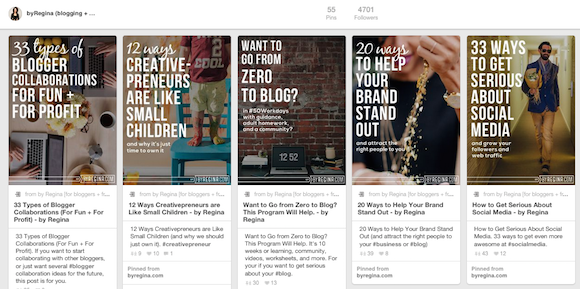
Pinterest users will notice the image & test before they read your the description.
Make sure you create an image with text that’s easy to read & understand.
It can be tempting to experiment with fancy fonts, but I would caution you on the use of many handwritten or calligraphy fonts. Many can be difficult to read.
The same goes for typeface. Regular, Bold, & Italic all have their place, but need to be used in the right setting.
They can either present a beautiful & stunning design or a muddled mess.
Take a look at byRegina for a perfect example of a balanced & branded design.
c. Create Value
There’s no need to reinvent the wheel. You have valuable content sitting at your fingertips.
Pull a quote from an evergreen blog article or create a series of images that highlight specific points from an email to your list.
Always think value proposition & solution when creating your pin images.
What value does your content provide & what solution are you offering to your Pinterest followers?
If you can determine how you help & who you help — and then sprinkle in clarifying answers to their most frequent questions — you’ll have a winning text based Pinterest image strategy!
GET GOOD AT WRITING – THE SECRET
5. Stephen King’s Pen Isn’t Magic
There’s an old writers joke:
Whenever Stephen King does a speaking engagement someone will always ask him, “what kind of pen do you write with?” or “Do you use a laptop or a typewriter?” and so on.
I’ve heard others dub this the “Stephen King’s pen” question.
The secret is: Write every single day. That doesn’t mean publishing every day, just writing once before you go to bed at night. Even a few words are enough. King himself used to lie and tell others he takes breaks for the Fourth of July and Christmas. In reality, he takes no days off.
Stephen King’s pen is just a pen. It’s only magic when he grabs it. When I grab it it’s no more useful than a fork. The only way to become a master like him is through practice. The keys on your laptop should feel like home; you should be at your desk more than your bed.
Writing is no joke. Get serious and go to work. Only then will it pay.
This is all I’ve got in six months of writing on Medium. I hope you’re able to utilize this to become a better writer. I really do think Medium is going to blow up this decade and become the YouTube of blogging.
So improving your writing right now is an incredible investment. Best of luck to you all and looking forward to reading your work in 2021.