

Introduction
Relying on SEO tactics to drive a blog’s growth is a strategy that’s collapsing in front of our eyes. This approach was always on shaky ground; Google’s primary aim has always been to surface quality content, constantly refining its algorithms to meet this goal better.
The influence of AI technologies like ChatGPT on traditional search and SEO will be profound and, for some, tragic. The effect will vary by niche, but mediocre, un-insightful, dull content that resembles flavorless cardboard is set to be crushed by AI.
Many ‘how-to” styled blogs will become irrelevant. Tech-based info sites like programming help, Microsft Office help sites, and many others are finished unless they pivot from purely instructional content to sources of inspiration.
This seismic shift will manifest in four key ways:
1. AIs provide answers, not just links.
“How-To” content and associated blogs are on the brink of extinction. The effect will differ significantly depending on the niche, but the impact will be existential for many.
Consider these two “How-to” examples.
Imagine you run a blog that assists programmers with technical challenges.
Let’s take a common scenario. A programmer wants to use CSS to darken a title gradually over four seconds.
In the pre-AI era, this would involve scouring search results, bouncing between websites and videos, and hoping for a solution. You might land on an almost-right answer on a website, then sit through a 10-minute video, finally getting the solution at the very end.
Total time spent? Roughly 15 minutes if you’re lucky.
Now, let’s run this query through ChatGPT.
Here is the response.
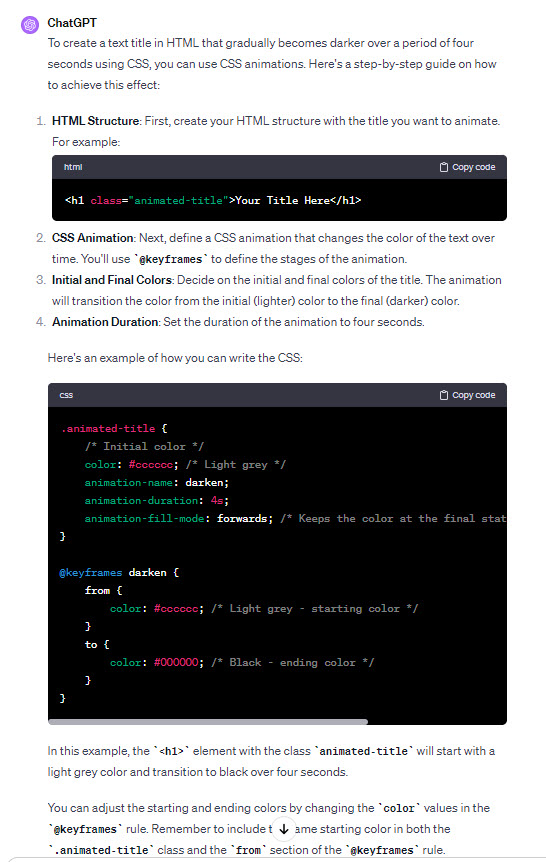
The same question, but the response is immediate, direct, and tailored to the problem. No sifting through pages, no halfway solutions, no time-consuming videos. It’s better than a straightforward answer – it’s the actual code.
This is where many traditional blogs face a significant challenge, especially in instructional or informational niches. AI’s ability to provide concise, accurate responses saves time and changes how users seek information. The efficiency gain is enormous.
Let’s turn the focus to food blogs.
To explore this, we will search for the ultimate Mac and Cheese recipe and pitch Pinterest against ChatGPT.
The search term: “What is the best mac and cheese recipe.”
This is Pinterest’s response:

Now let’s look at the ChatGPT response.
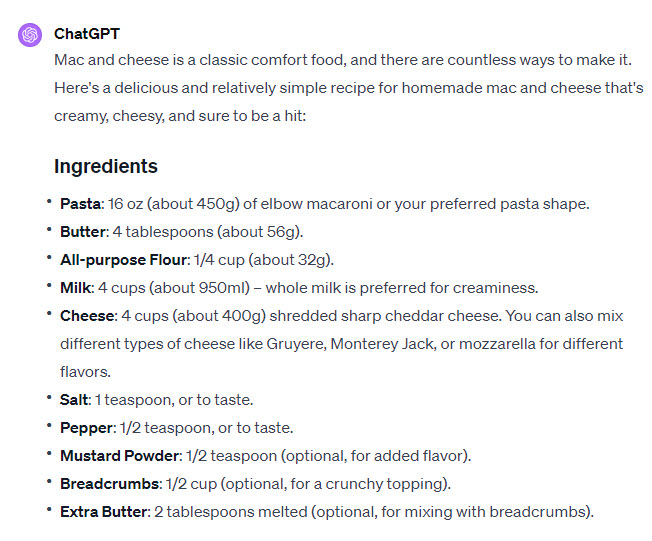
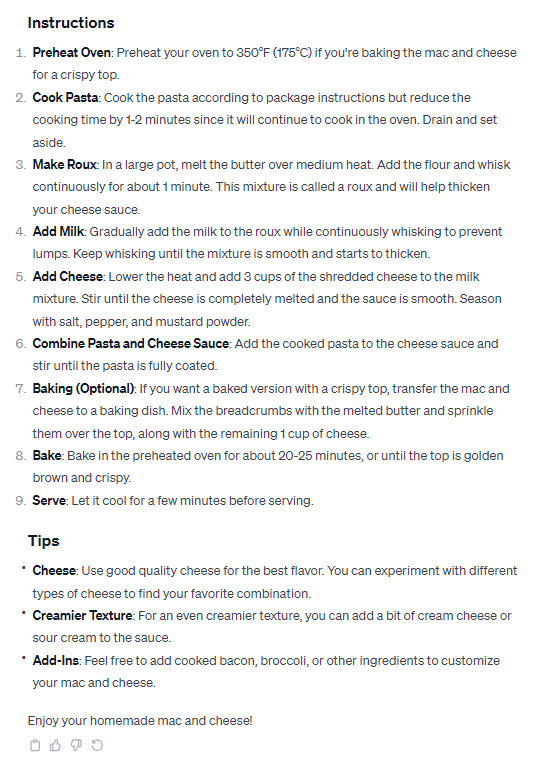
I would give this round to Pinterest.
For food enthusiasts, Pinterest’s visually rich and engaging platform offers more than just recipes; it provides a visually appealing response in a niche where visual appeal is essential. (You eat with your eyes first).
On the other hand, the AI presents a quick and direct solution. However, these responses will rarely cater to the deeper culinary passions of food enthusiasts.
For niches where creativity and inspiration are core, such as design, food, fashion, makeup, clothing, swimwear, and others, the immersive experience offered by platforms like Pinterest and the opportunity to create blogs that cater to this exact need is still hugely relevant. The vibrant images and the journey of discovery feed into the human craving for visual inspiration and storytelling.
Conversely, blogs that have carved a niche in offering technical solutions and ‘How-To’ guides are in choppy waters. AIs’ rapid and accurate responses to technical queries mean the traditional blog format for such content will struggle to stay relevant.
2. Search Engines are Trending This Way Also – Providing Answers, Not Just Links
Search engines, like Google and Bing, are on the move. They realize that AIs like ChatGPT represent an existential threat and, in response, are moving away from the traditional SERP response (a Search Engine Result Page list of links) towards providing the same types of direct answers the AIs provide. Sifting through websites for information and answers will often become a thing of the past.
Google’s Gemini and Bing’s (Microsoft’s) CoPilot are at the forefront. This transition will only increase the speed at which informational sites disappear. These sites will evolve and change to provide inspiration and innovation or vanish.
Introduced by Google in 2023, the “Google Search Generative Experience,” or SGE, was an advanced AI-enhanced search update. Using generative AI, it understands and interprets the intent behind user queries and then generates comprehensive, context-aware responses, providing users with more accurate, conversational, and nuanced answers.
It is a significant evolution in search technology, offering a more interactive and intuitive search experience, and will surely significantly hurt traditional SEO-focused blogging tactics.
3. Long Tail Keyword strategies are over in the Age of AI
AI will render long-tail keywords, the beginner bloggers’ much-touted path to blogging growth, obsolete. The ability of the search engine to re-write search queries and discern the intent of the search regardless of the keywords used will render semantically similar keywords irrelevant.
Relevance, intent, and meaning are what Google is looking for. Pattern matching similar words will give way to relevance matching in the search query.
This is already happening. Google’s SGE (Google Search Generative Experience) update in 2023 is already exploiting AI to target user search intent rather than pattern-matching keywords.
ChatGPT plugin “Perfect Prompt” is a tool that can do much the same with a twist. This tool reinterprets the searcher’s intent from the original prompt and crafts better, more precise queries on the fly.
Consider this example from “Prompt Perfect”.
A user types “What is the best RV for the elderly.” Perfect Prompt steps in, tweaking this to a more targeted query.
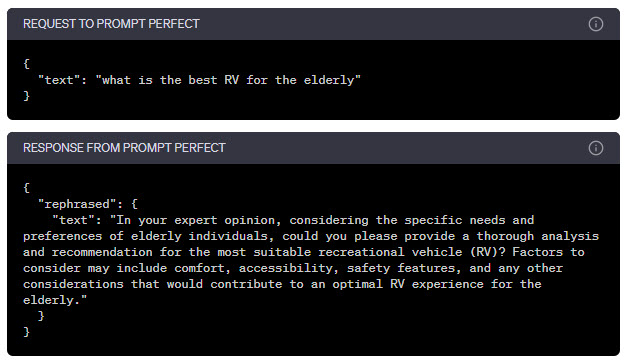
For bloggers, both newcomers and veterans, who have relied on targeting long-tail keywords to grow their audience, this change marks the end of an era. The strategy that once provided a niche foothold is now fading into irrelevance. Bloggers must adapt to the new dynamics of content relevance and produce quality content as all relevant content, regardless of keyword, is now the competition.
4. Google’s AI-enhanced PageRank System will sort the wheat from the chaff
The incorporation of sophisticated AI technologies into Google’s page-ranking system will lead to a significant evolution of their algorithms. A more refined differentiation between uninspired, formulaic content and genuinely captivating, insightful material will rapidly sort the wheat from the chaff.
Google’s 2023 HCU (Helpful Content Update) has begun the process. Content that demonstrates expertise, depth, and value to readers is being rewarded while simultaneously penalizing websites whose content is optimized for search engine rankings.
All types of online content, including articles, blogs, and product reviews, were affected. It was followed by the predictable howls of resentment from bloggers who fell foul of the update.
As a result of this shift, high-quality content – whether written blogs, videos, or podcasts – will increasingly take center stage. This evolution underscores the importance of originality and depth in content creation across all mediums.
Navigating the New Blogging Landscape: Quality and Inspiration Will Take the Lead
So, what does this seismic shift in search and content ranking mean for bloggers?
Is it the end of blogging?
Absolutely not!
Instead, it signals a call to action on two critical fronts:
The Age of Exceptional Content
The time has come for many bloggers to improve their game. Producing run-of-the-mill content won’t cut it anymore. Google’s AI-infused algorithms will be sifting through content at an unprecedented rate, ruthlessly separating the good from the bad. Think of it as the internet’s quality control, filtering out mediocrity in favor of content that truly shines.
Inspiration Over Information
Many readers seek inspiration, not just how-to guides or solutions. This is where magazine-style blogs excel – captivating, intriguing, and filling a niche with compelling stories. These blogs target a vast audience of readers eager to discover what they don’t yet know. In this realm, inspiration is king.
Embracing this new era will see a welcome end to SEO obsession. The basics of SEO will still be necessary. You still have to help Google find you and understand your content. But relying on Google alone to build a blogging business is over – as it should be. It was never good business practice.
And the genuinely great blogs of the past never did. “Search” was just one channel amongst the many that got them in front of their target audience.
Traditional marketing strategies – think classic advertising and public relations efforts on social media – will become the main avenues to connect with audiences.
Bloggers must build product relationships that see their consumers returning repeatedly.
This shift back to the roots of real marketing is not just a change; it’s an exciting opportunity. It’s a chance to bring creativity, authenticity, and genuine engagement back to the forefront, leaving mediocrity in the dust.
The future is bright, challenging, and incredibly rewarding for those ready to rise to the occasion.
0 Comments